• Skip to primary navigation
  • Skip to main content
  • Skip to primary sidebar
Nexenta Blog

Nexenta Blog

Global Leader in Software Defined Storage

  • About Nexenta

Software-Defined Storage

Managing Dynamic Storage Demands at ServerCentral

December 4, 2014 By Nexenta

Allison Darin, Director of Communications & Public Relations, Nexenta Systems, Inc.

Scalability and economics go hand in hand as part of the NexentaStor implementation for ServerCentral. ServerCentral has been delivering managed data center solutions since 1999 for customers such as Ars Technica, CDW, DePaul University, Discovery Communications, New Relic, Outbrain, Shopify, TrueCar, and USG.

They recently added software-defined storage to their IT toolkit through their deployment of NexentaStor. Take a look at our new case study here for lots more information.
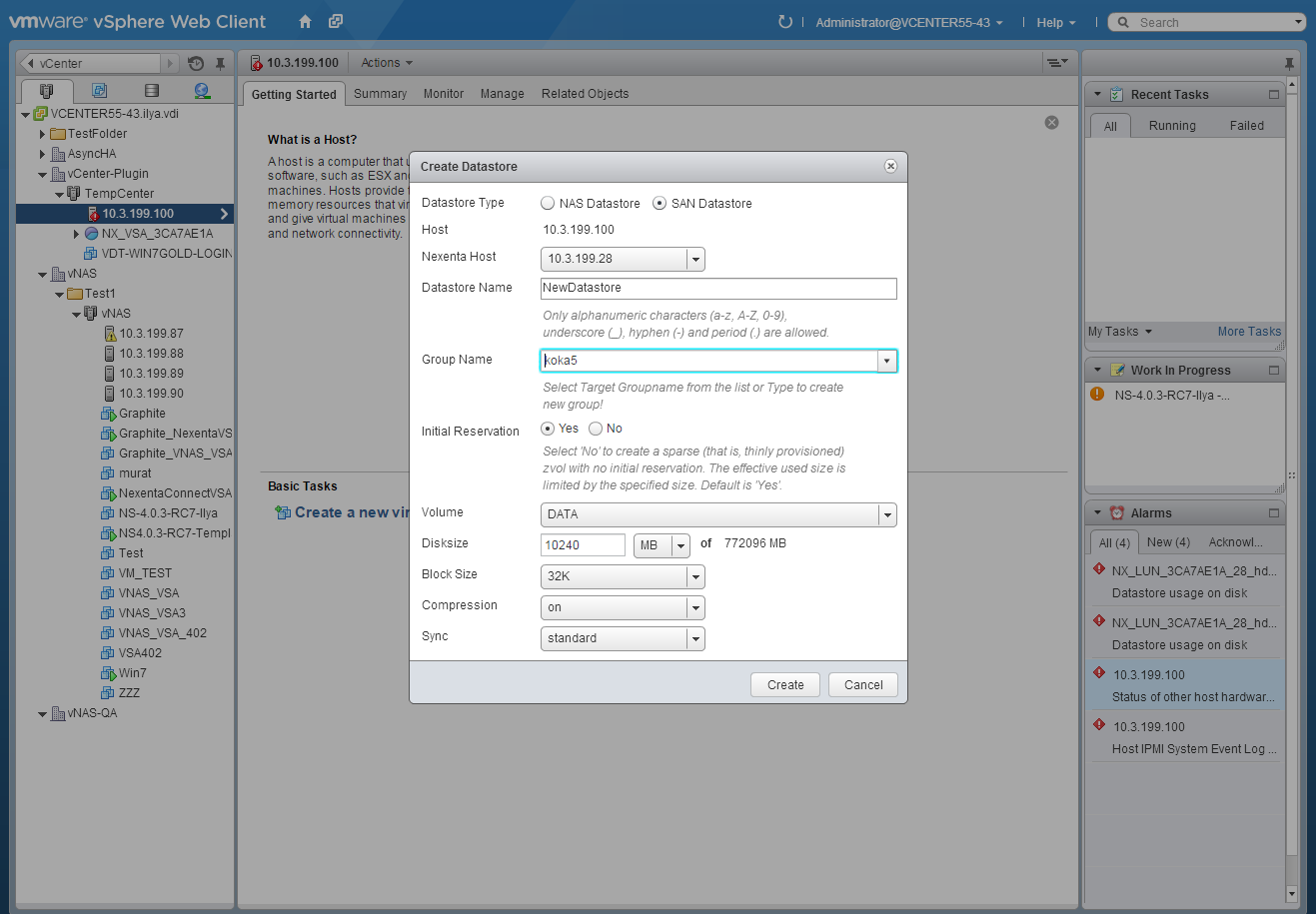
Managing Software-Defined storage for your virtualized infrastructure just got a whole lot easier.

September 19, 2014 By mletschin

Nexenta is proud to announce our first vCenter Web Client plugin to support the NexentaStor platform. The NexentaStor vCenter Web Client Plugin is a plug-in for vSphere 5.5 and NexentaStor 4.0.3 that provides integrated management of NexentaStor storage systems within vCenter. The plug-in will allow the vCenter administrator to automatically configure NexentaStor nodes via vCenter.

VMware administrators can provision, connect, and delete storage from NexentaStor to the ESX host, and view the datastores within vCenter.

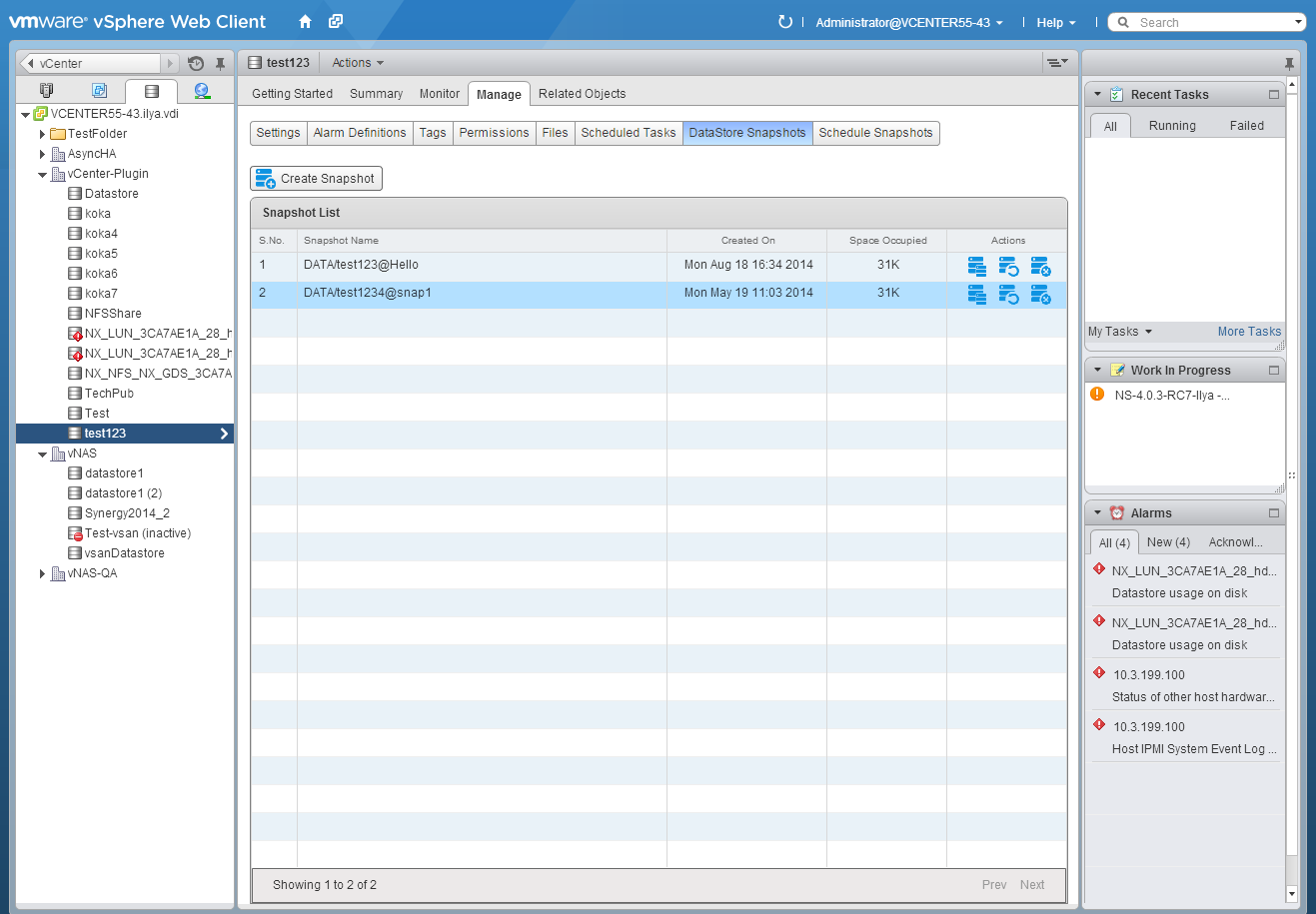
04CreateiSCSINot only can you provision the storage but managing it is also simple with integrated snapshot management.

05SnapshotThe plugin also allows for closer analytics and reporting on the storage through vCenter as detailed below.

Check out the screenshots below, and download the vCenter Web Client Plugin today from the NexentaStor product downloads page.

General details about Storage:

  • Volume Name
  • Connection Status
  • Provisioned IOPs
  • Provisioned Throughput
  • Volume available space and Used space

Storage Properties

  • Datastore name
  • NFS Server IP address
  • Datastore Path and capacity details

Datastore Properties:

  • Total capacity
  • Used capacity
  • Free capacity
  • Block size
  • Datastor IOPs, Throughput, and Latency

Snapshot Management:

  • List existing snapshots
  • Create new snapshots
  • Clone existing snapshots
  • Restore to a snapshot
  • Delete Snapshots
  • Schedule snapshots

End-to-End Datastore Provisioning:

  • Creating a new volume in Storage Array
  • Attach the volume to host as datastore

Cheers – It’s been a blast! – From Evan Powell

December 4, 2013 By Nexenta

After six years I’m leaving Nexenta.

I could not be prouder of what we’ve built at Nexenta.  We took an idea that at the time was radical – let’s bring openness right to the foundation of IT, to the storage itself.  And we pulled it off.

Along the way I learned a lot including:

  • Team, team, team – the best team beats the brilliant individual every time
  • ZFS is great – and not perfect; thank you Sun for ZFS and Solaris (now Illumos).  It says a lot about the requirements of storage that even Solaris, arguably the 2nd most deployed OS for mission critical enterprise environments was not fully mature for storage. We’ve added a lot of fixes to Illumos over the last few years.
  • And much more that I’ll just call “experience.” Much of what you learn when you start and build companies ends up sounding like common sense; for example, what kind of executive is right for what stage of a company or how do you make money on open source?

So, what am I up to now?  A few answers:

  • Continuing to spend time as an EIR with xSeed.  Over the last several months I’ve beenblessed to meet many start-ups while an EIR at xSeed.  xSeed is an unusual seed fund.  They are deep in enterprise and have arguably the best ties of any early stage enterprise focused fund into Stanford and Berkeley.  They are old school in that they are definitely NOT spray and pray (which can be a great strategy actually).  Instead, they seek to go deep and to understand a domain and to find within that domain the very best entrepreneurs; they then surround that entrepreneur with coaches and advisors and much more than just capital.  In addition to meeting many companies I’ve been privy to many mind expanding discussions at xSeed about companies, and domains – about everything from the chess of strategy to the tough soft stuff of finding, retaining and sometimes transforming teams.  So I’ll be spending a bit more time with my colleagues at xSeed.
  • Finally, the rumors are true – I’m helping found another company.  We are in stealth mode.  I can tell you it is NOT in storage (although storage infects everything in IT).  And that it IS still very much on the side of openness and open source.  As you might imagine, I did a huge amount of diligence and founder dating before deciding to bet the next X years of my life on the opportunity.  So it is out of the frying pan and into the fire for me.

Here’s what I’d like you to do:

  • Stay in touch.  Maybe I’m getting to be sentimental in my middle age, but the people I’ve met as Nexenta has grown up are truly extraordinary.  You know who you are. You are the early channel partners who never shied away from offering “constructive feedback.”  You complain too much, but I love you.  And likewise you are the team members that parked your personal lives for weeks, months and years at a time as we fought the good fight.  Despite many missteps and the joy of starting a company during the worst financial collapse since the 1930s, you stayed true to a vision of more open storage and of what we now call software defined storage.  And maybe most importantly – you are the thousands of customers that bet your company’s data on Nexenta and sometimes bet your jobs and careers as well.  Follow me and, yes, complain to me at @epowell101.
  • Insist on excellence.  Like many entrepreneurs I think I start companies because half assed solutions to important problems make me sick (plus I probably have a complicated relationship with authority).  At a fundamental level – at the level of a life’s mission – I am dedicated to finding waste and calcification and cracking through it somehow.  How many of the world’s problems would be less serious if we all talked less and fixed stuff more?
  • Insist on openness and transparency.   Go open, it is the future, and it will make your company a smarter, more competitive business; don’t cop out and defer the decision onto the next guy in your job.  Eventually people will be fired for buying vendor X’s product; don’t be the last buyer to abandon ship when a legacy vendor goes aground.  Also, please be open within your organization as well.  Collectively we are all smarter than any one of us; by remaining open, we’ll get better technology, better team work, and happier lives.

I guess I did get sentimental.

Thanks for tolerating that sentimentality and for reading this blog and thanks everybody for helping a crazy vision come true.  Stay tuned here or via @epowell101 on twitter.

-Evan Powell

How Does Software Defined Data Storage Equate to Savings?

December 2, 2013 By Nexenta

Ask any CIO what their greatest concern is, and they’ll invariably come up with some variation of concern over the budget. It’s a Catch-22 for many businesses when it comes to technology: There is always a faster, more reliable option, but it always comes at a cost. So how did the big guys get to the top? How have they learned to strike a balance between cost and effectiveness without compromising either entirely? When it comes to data, more and more have chosen to look at software defined data centers. Here’s why:

There’s no question that data is growing exponentially as we frequently use technology for every aspect of our lives – from shopping and paying bills to reconnecting with friends on social media. All of these things produce data – a lot of data in fact. Studies have estimated that we create 2.5 quintillion bytes of data each day. All of this data needs to be stored, and it can be quite costly. Some organizations are spending as must as 40% of their IT budget on storage solutions.

Therefore, government agencies, credit card companies, health care facilities, social media sites, retailors and many other entities are constantly looking for ways to store this data efficiently and affordably. Software Defined Data Centers (SDDC) address all of these concerns and more because they take the virtues of virtualization and apply them to data storage.  In fact, our customers have reported that they have saved as much as 75% in storage costs.

Here are just a few of the ways businesses can save using software defined data storage:

Scalability: Did you know that 90% of the data out there has been created in the last two years? Just think about what this could mean in terms of data storage ten years from now. As data grows, more and more hardware must be purchased to keep up with demand. Software defined data storage solutions are more easily scalable, with greater savings.

Operational Cost Savings: We talked about scalability, but what about the problems that traditional storage methods present in regard to operational costs? Energy costs to cool the storage system, labor costs to monitor and troubleshoot the system, and maintenance costs are just some things that are negated through a software defined storage system.

Open Source Opportunities: Hardware storage systems are closed systems. You are bound by specific vendors, which could limit your flexibility and opportunities to adapt when needed. Because software defined data storage solutions are often open-source, you can take advantage of the latest technologies and adapt your storage solution for the lowest cost.

For more information about the benefits of software defined data storage solutions, contact us today.

Nexenta Systems-Powered Storage Solution Achieves 1.6 Million IOPS

September 30, 2013 By Nexenta

Nexenta has achieved 1.6 million IOPS (Input/Output Operations per Second) and high-availability with no single point of failure. Comparable solutions from proprietary vendors cost significantly more than the Nexenta and Area Data Systems solution and cannot guarantee high-availability. With the combination of Nexenta’s Software-defined Storage, NexentaStor™, and high-performance, all-flash hardware, there is now a clear enterprise-class alternative to meet the scalability demands of big data.

“Our customers can now reach well over one million IOPS and capitalize on big data opportunities without breaking the bank on proprietary storage technologies that cost hundreds of thousands of dollars,” said Bridget Warwick, Chief Marketing Officer, Nexenta Systems. “This is further proof that Nexenta’s Software-defined Storage is changing the economics of the enterprise storage market.”

Nexenta is demonstrating the 1.6 million IOPS storage configuration at Intel® Solutions Summit 2013 from March 19-21, 2013 in Los Angeles, Calif. Nexenta is a Silver Sponsor and will be at its booth in the storage zone to discuss the enormous opportunity for Intel channel partners to drive ideal storage solutions, powered by Nexenta, to their customers.Architecture recipes using Nexenta and Intel products are listed on Intel’s website at: http://www.esaa-members.com/recipes/advSearchList/182.

  • « Go to Previous Page
  • Go to page 1
  • Go to page 2
  • Go to page 3
  • Go to Next Page »

Primary Sidebar

Search

Latest Posts

Introducing “The Essential”- A Quick-Start NexentaStor Virtual Storage Appliance

Taking the EZ-Pass Lane to a Hybrid Storage Cloud

File Services for HCI and Block Storage Simplified

“NAS-up” Your Hyper-converged Infrastructure or SAN with NexentaStor (and get hybrid cloud, too)

NexentaCloud Complements On-Prem NexentaStor for Hybrid Deployments

Categories

  • all flash
  • cloud
  • Corporate
  • Data Protection
  • Dell
  • NAS
  • Object Storage
  • Raise Your SDS IQ
  • Software-defined data center
  • Software-defined storage
  • Uncategorized
  • Virtualization

Nexenta Blog

Copyright © 2026