• Skip to primary navigation
  • Skip to main content
  • Skip to primary sidebar
Nexenta Blog

Nexenta Blog

Global Leader in Software Defined Storage

  • About Nexenta

Software-defined storage

Raise Your SDS IQ (1 of 6): Practical Review of Scale-up Vendor-Defined “SDS”

May 10, 2016 By Nexenta

by Michael Letschin, Field CTO

This is the first of six posts (aside from the Introduction) where we’re going to cover some practical details that help raise your SDS IQ and enable you to select the SDS solution that will deliver Storage on Your Terms. The first SDS flavor in our series is Scale-up Vendor-Defined “SDS”.

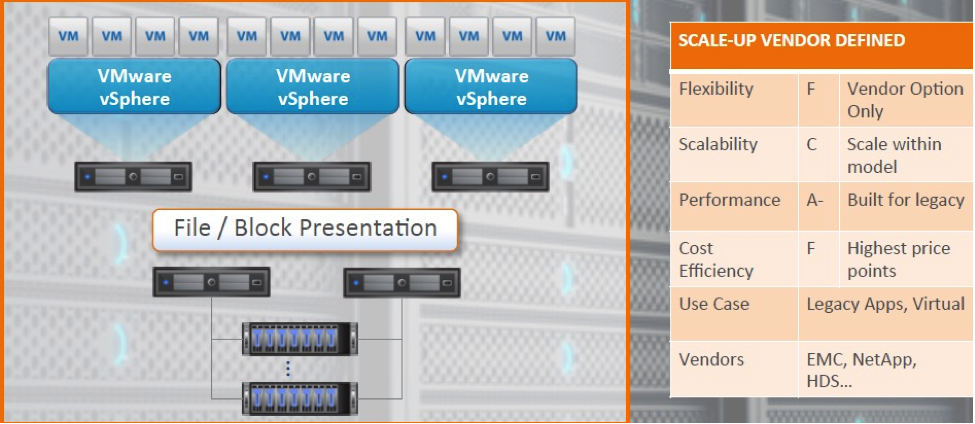
Scale-up Vendor-Defined “SDS” is where most of the traditional “big box” vendor solutions lie – think EMC’s VNX, NetApp’s FAS, or IBM DS4000 Series – each one being one or two usually commodity head nodes with JBOD behind it. While sold as an appliance, the argument is that SDS comes into play as front-end software that delivers REST-based management with rich APIs, to enable easy, automatic provisioning and management of storage.

Companies choose scale-up vendor-defined “SDS” often because it’s a well recognized brand, they have the vendor in-house already, and it appears to bring SDS benefits while maintaining a familiar in-house infrastructure. Scale-up Vendor-Defined “SDS” is often selected for legacy applications and some virtual apps, largely because its performance in these use cases is excellent. It’s a great choice if you’re running virtual machines with NFS, Exchange, or MS SQL. But, it’s still vendor-defined and not true SDS, so your hardware choices, and your flexibility, are restricted. It also means giving up one of the core SDS benefits – cost effectiveness – because you’ll be paying a premium for proprietary hardware. And that hardware is generally only one or two head nodes, so scalability is limited too.

Overall grade: D+

See below for a typical build and the report card: scale-up_vendor-defined
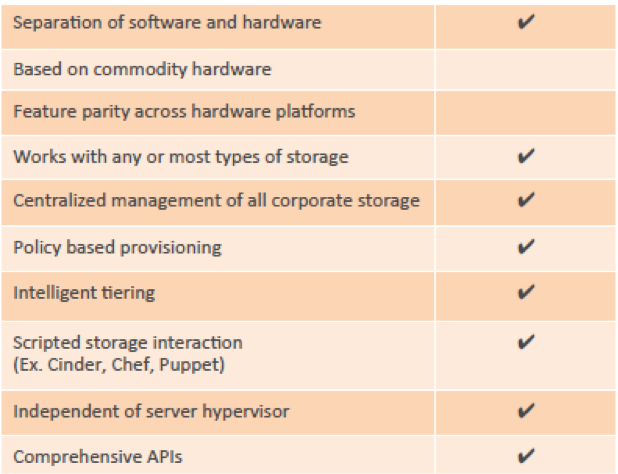
scale-up_vendor-defined_checklist

Watch this space for the next review in our series – Scale-up, Software-Only SDS

Is 2016 the year of the software-defined data center?

May 7, 2016 By mletschin

Even with my 20 years of experience working in technology, I am just a baby compared to some people I have encountered along the way.

Still, I sometimes think about the “old days” in IT. It was a time when data centers were dominated by mainframe systems and midrange monoliths like the AS/400. A time when virtualization was something done only on these big systems, and the only need for an x86 system was under your desk to access a mainframe when you didn’t have a classic thin client.

When my career in IT really began, I was working with systems like Windows NT and Exchange 5.5, and we were creating Web pages with this mysterious language called HTML that magically made things appear. Even in those days, there was this thought that there was no need for companies to be beholden to the largest vendors.

There was a notion/belief in the early 2000s that with the growth of VMware, eventually the data center would become a blend of multiple vendors and companies would be able to take back their own infrastructure, enabling them to control the way they supported their business. This transition marked the evolution from the traditional data center to the commodity-based data center, driven by business needs and created using software, rather than the monolith systems that big vendors charged exorbitant amounts for.

Fast-forward to 2016

Are we there yet? Not quite, but this could be the year. Most enterprises have nearly 90% of their systems virtualized on VMware, Xen or KVM and are managed by newer solutions like OpenStack. 2016 could finally be the year we see the commodity-based data center become reality.

To make this happen, there are so many components that need to be in the right place. We need to see x86 servers with enough power to support large database systems — check. We need the ability to choose between multiple vendors that all produce a similar-quality product, but differentiate themselves with their support and supply chain — check. We need to have networks that can handle multiple systems and the communication between them, without losing packets and without being based on a single large infrastructure — check. (Well, sorta . . . we will get to that one in a few.) Finally, we need software to drive all these systems and define the solutions, whether it is storage, compute or even networking.

We are just about there and are seeing an influx of companies that can provide these services, but can they unseat the incumbent large, publicly traded vendors that look to buy up all the small fish? That just may be the key to 2016 being the year of change for the data center we have all dreamed about since we walked away from worrying about what happens when the clock strikes midnight for the new millennium.

Over the next couple of blogs I will take a look at each of the categories and see if we are really as close as we think to 2016 being “The Year,” starting with the server and compute side.

IT Infrastructure Breaking Down? It’s Time for ChatOps…

BrandPost Sponsored by Atlassian

IT Infrastructure Breaking Down? It’s Time for ChatOps…

ChatOps helps bridge the tasks of reporting and communications for faster, better-informed incident management

Won the battle and the war

There is little doubt that the data center is now dominated by x86 server hardware. The hardware can run with multiple CPU manufacturers, and has more cores than we could imagine in the ’90s and memory levels that exceed what helped put a man on the moon. All of this hardware is going to support everything from the large single applications to scale out big data apps that let us analyze every picture that was posted on Instagram or Facebook about kittens in the last 24 hours.

Let the vendors compete for you

Most users probably have their preference now in server vendors, and it is all about the extras these companies provide. It is not about the components within the servers. Most network cards are from one or two companies, and most processors are from one of two companies — you may have hard drives from multiple firms, but overall it’s just different-shaped, bent metal with a different label on the front.

The true differentiator for vendor choice comes in the form of supply chain and parts availability. The supply chain has begun to collapse around fewer global vendors, making it easier to price match between them. If you are only looking for regional or local support, that too has limited choice, and all the vendors know it. The choice is now truly in the hands of the consumer and, if planned out, can result in a race to the bottom on price, along with increased “hand-holding” when the equipment arrives.

GleSYS’ joint NexentaStor/InfiniFlash system deployment to be focus of upcoming webinar

May 4, 2016 By Nexenta

In April, we announced that GleSYS Internet Services AB (GleSYS), a next-generation cloud platform provider based in Sweden, had deployed ours and SanDisk’s joint All Flash Software-Defined Storage Solution. The NexentaStor/InfiniFlash solution delivers cost effective, high performance storage architecture, empowering GleSYS and its customers to quickly scale capacity as required.

Providing hosted internet solutions to nearly 3,500 customers around the world, GleSYS specializes in offering its public cloud services to small- and medium-sized businesses on a self-serve basis.  Prior to selecting the joint solution, the company was struggling to ensure the reliability of its storage solutions for customers, many of whom require extra performance provisioning instantly. However, GleSYS now has access to flexible and reliable storage architecture and, with unparalleled and limitless scalability to boot, the company has a tool that can support its impressive year-on-year growth predictions.

The deployment has been a huge success with GleSYS able to provide powerful and reliable cloud architectures to its increasing customer base. The solution has provided the company with numerous technical benefits, including:

  • The new architecture runs at a constant 20k Input/Output Operations per Second (IOPS), with a latency of less than 1.5ms in its daily operations. The previous solution was only able to reach a maximum of 12k IOPS
  • While IOPS currently peak at around 80k, GleSYS believes this is not the limit of the solution, but rather the max utilization that it has seen from its current hardware
  • In regards to data center footprint, GleSYS has a 64TB hybrid storage solution allocating 16U. The joint solution can hold up to 512TB in only 7U

The GleSYS success story will be discussed in more detail during an upcoming webinar, May 11th 2016, 7am PT.  Executives from GleSYS, Nexenta, SanDisk and Layer 8 will take a deep dive into the challenges that the organization was facing with its legacy storage set-ups, and how the NexentaStor/InfiniFlash system is ensuring better storage performance and reliability for the company and its customers. Register for the webinar here: https://www.brighttalk.com/webcast/12587/198547

For more information on the GleSYS deployment, the full case study can be viewed here (English) or here (Swedish).


It’s time to raise your SDS IQ

April 26, 2016 By Nexenta

by Michael Letschin, Field CTO

If you’re like other storage buyers – you’re going to invest in a solution, you want storage on your terms – optimized for your organization, its requirements, now and in the future. When it comes to distinguishing the wealth of Software Defined Storage (SDS) solutions from one another, you probably have a better shot of telling monkeys apart (note: there are 260 species of monkeys). Even respected analysts like Gartner, IDC, 451 Research and TechTarget have different SDS definitions – SDS must be software only, SDS can be hyperconverged, SDS is open source, or SDS can be hardware-based.   What most people seem to agree on is that SDS enables storage services through a software interface, and often runs on commodity hardware, enabled by the decoupling of storage software and hardware.

Yet that still doesn’t help answer the question, what meets YOUR needs? It may seem a little unconventional for a vendor blog, but our goal in this series (expect another six blogs after this one) is to give you some practical information on SDS types – what are the flavors, what works best where, how different SDS types rate against common use cases, and what you should select to bring up your organization’s SDS IQ.

We’re going to cover six types of SDS solutions:

  • Scale-up Vendor-Defined “SDS”
  • Scale-up Software Only
  • Scale Out
  • Hyperconverged
  • Virtual Storage Appliance
  • Containerized

Review our report cards to see whether your favorite SDS solution made the grade – we’ll look at each type and rate them on four critical categories: flexibility, scalability, performance, and cost; we’ll suggest the best use cases for each solution, and even share a few vendors to look at. We’ll be using a 5 point grading system:

  • A: Excellent; well-rounded and recommended solution
  • B: Very Good; above average solutions, especially for certain use cases
  • C: Passing; improvement needed for overall usage
  • D: Close fail; almost passing, solution with numerous gaps
  • F: Failing, not a workable solution

What’s on your SDS wish list?

To help you raise your SDS IQ, it’s helpful to start by doing your homework – what’s on your SDS wish list? For example, making sure you’re still in charge of managing drives, so you can handle predictable drive failures. Many organizations also want policy-based provisioning using REST-based APIs, specifically thin provisioning and scripted storage solution. Tiering is also often a must-have for SDS because of its ability to match data with storage types and maximize your return on investment. You might also be looking for SDS that’s independent of hypervisors. Hyperconvergence expands the portfolio of solutions even further. Take a few minutes to think through what matters most, and we’ll help you figure out how to get it.

Watch this space for the first review in our series – Scale-up, Vendor-Defined “SDS”

Nexenta has joined Intel’s new Storage Builders Program for Open Software-Defined Storage

April 19, 2016 By Nexenta

by Nexenta

Earlier in April, Intel hosted its Intel Data Center Group (DCG) Cloud Day. The event brought together its vast network of industry partners across the cloud and networking space, as well as journalists, analysts and other influencers, to discuss the the industry’s progress in the adoption of Software-Defined Infrastructure (SDI), highlighting the importance of Software-Defined Storage (SDS) to SDI. As part of this discussion, Intel announced it would be launching a Storage Builders Program – an extension of the Intel Builders Program.

We were delighted to be invited to join the exclusive group of vendors supporting the program – many of which we’ve worked with before and we’re excited to extend those partnerships further.

The program is a cross-industry initiative designed to increase ecosystem alignment, ignite innovation, reduce development efforts, lead open storage standards development and accelerate adoption of intelligent, cost-effective and efficient SDS.

There is no doubt that SDS has become an increasingly important market segment, and the introduction of this program is yet more evidence of that fact. Organizations across the world are finding that their legacy storage systems just aren’t up to scratch, cost far too much and, on top of that, they’re tied to a single vendor. At Nexenta our long-term mission has been to make storage open and we’re excited that Intel has the same future in mind.

As a participant in the program, we’ll continue to build on our current OpenSDS offerings, but will have the added benefit of using Intel’s expertise to create joint solutions for customers. We’ll have the ability to collaborate with other Intel Storage Builders members to drive broader market adoption of software-defined technologies across the data center and seriously accelerate traction in the storage market.

Our participation in the Intel Storage Builders program supplements our existing and continued support of all Intel server providers including Cisco, Dell, Hewlett Packard Enterprise (HPE), Inspur, Lenovo, SuperCloud and Supermicro.

“Supermicro is raising the bar on performance and density with the Industry’s broadest portfolio of all-flash NVMe storage solutions and complete support for Intel’s latest Xeon E5-2600 v4 processors across our server platforms,” said Don Clegg, VP of Marketing and Business Development at Supermicro. “As a member of Intel Storage Builders with longstanding partner Nexenta, we are developing and deploying next generation software-defined storage solutions which deliver the most innovative, highly scalable, hyper-converged infrastructure, with lowest overall TCO.”

“We are proud to join Nexenta and select others as part of the Intel Storage Builders program. We’ve worked with Nexenta for a long time in supporting our mission to provide customers with the industry’s widest-range of tested and validated OpenSDS solutions,” said Travis Vigil, Executive Director Product Management at Dell Storage. “We are excited to continue working together along with Intel to produce high-end results for our customers.”

“Nexenta’s solutions will enable our customers to deploy flexible, software-defined storage environments on purpose-built HPE Apollo 4000 big data servers,” said Susan Blocher, Vice President of Compute Solutions at Hewlett Packard Enterprise. “The collaboration between HPE, Nexenta and Intel ensures our customers benefit from the combined innovation and high-quality of our next generation solutions.”

“Nexenta is a strong partner in supporting our growth in the enterprise storage market,” said Stuart McRae, Director of Product Marketing for the Lenovo Storage Business Unit. “At Lenovo, we strive to bring innovative customer value to our enterprise customers, and together with Intel and Nexenta, we will continue to expand our reach to bring new economics to data center storage. “

“We are pleased to partner once again with Nexenta, as they continue to support our company’s vision of shaping the future of software-defined storage by creating unprecedented value and opportunities for our customers and partners,” said Philippe Vincent, CEO at Load DynamiX. “Ensuring that software defined storage will perform and scale to enterprise data center requirements is a key focus of Load DynamiX. We are confident that, together with other Intel Storage Builder partners, we can achieve these goals.”

“Nexenta has proven to our customers the joint benefits of SDS in conjunction with our expertise in cloud computing hardware, software and services,” said Yuzhen Fang, CEO at SuperCloud. “We look forward to continuing development of these solutions with both Nexenta and Intel.”

“Nexenta and VMware have worked together for many years to provide mutual customers with flexible storage solutions to enable increased efficiency and availability, while lowering costs,” said Howard Hall, senior director, Global Technology Partnering Organization, VMware. “We look forward to working with both Nexenta and Intel to create additional value and drive broader adoption of software-defined technologies.”

For more information, visit: Storage on Your Terms: Nexenta Software Defined Storage with Intel


  • « Go to Previous Page
  • Go to page 1
  • Interim pages omitted …
  • Go to page 3
  • Go to page 4
  • Go to page 5
  • Go to page 6
  • Go to page 7
  • Interim pages omitted …
  • Go to page 9
  • Go to Next Page »

Primary Sidebar

Search

Latest Posts

Introducing “The Essential”- A Quick-Start NexentaStor Virtual Storage Appliance

Taking the EZ-Pass Lane to a Hybrid Storage Cloud

File Services for HCI and Block Storage Simplified

“NAS-up” Your Hyper-converged Infrastructure or SAN with NexentaStor (and get hybrid cloud, too)

NexentaCloud Complements On-Prem NexentaStor for Hybrid Deployments

Categories

  • all flash
  • cloud
  • Corporate
  • Data Protection
  • Dell
  • NAS
  • Object Storage
  • Raise Your SDS IQ
  • Software-defined data center
  • Software-defined storage
  • Uncategorized
  • Virtualization

Nexenta Blog

Copyright © 2025